
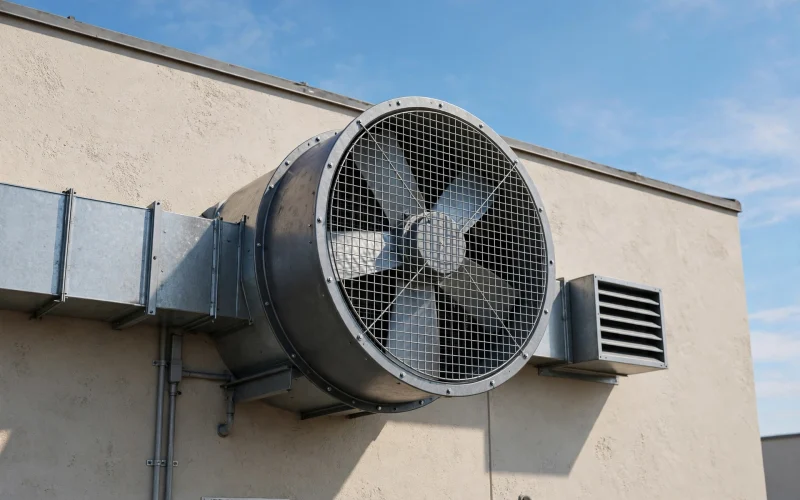
A Dayton exhaust fan pushes stale air, fumes, heat and moisture out of your garage, workshop or warehouse. You need the size of your room and how fast you want one full air change.
You need a tape measure, the size of your room, and one decision: does the air go straight out through a wall, or travel through ductwork, the tube that carries air from the fan to the outside. The sums below give you the CFM, and the fan to buy with it. CFM means cubic feet of air moved in one minute.
Dayton exhaust fans
Do it in this order.
- Work out the size of your room: length, width and height in feet.
- Work out the cubic feet: length times width times height.
- Pick how fast you want one full air change: every 3 to 5 minutes for a workshop or garage, every 1 to 2 minutes for a kitchen or fume heavy space, every 5 to 10 minutes for a warehouse.
- Divide the cubic feet by the minutes. That is the CFM you need.
- Match the CFM to a fan below.
Take a 20 by 30 by 10 ft shop. It is 6,000 cubic feet, and a 3 minute air change needs 2,000 CFM.
The live page plans 10,000 to 15,000 CFM of exhaust capacity for a warehouse. Treat that 10,000 to 15,000 CFM planning range as a starting point only, and use the formula for your own building. A 100 by 50 by 20 ft warehouse is 100,000 cubic feet, which needs 20,000 CFM at one air change every 5 minutes and 10,000 CFM at every 10 minutes. So a big warehouse needs more than the top of the starting range, and the formula tells you the true number for your building.
Ductwork, slatted covers and grilles slow the air down. A slatted cover is the louver over a wall opening. A grille is the cover over the end of a duct. The longer the duct and the more bends and covers in the way, the harder the fan must push, and the less air comes out the other end. That push is what the product page calls static pressure. Find the CFM listed for a duct run like yours on the product page, and buy a fan whose listed CFM at that push still meets your need. Through a long duct you get less than the rated figure, so size from the duct figure, not the headline figure.
If the air feels stale or smells of fumes, you need exhaust. If the air is fresh but still, you need circulation. Many shops need both: an exhaust fan to pull bad air out and a circulator to keep good air moving.
If you are still deciding between the two, the How to Choose a Dayton Fan guide explains how CFM maps to room size.
For cooling a large space by moving air around it instead of pushing air out, drum fans move the most air.
If you need portable spot cooling instead of fixed exhaust, pedestal fans move where the work moves.
Types of exhaust fans
Wall mount. A wall mount exhaust fan sits in a hole cut in a wall and pushes air straight outside. The 10D954 is the wall mount fan in this guide: 12 inch, 889 CFM, for commercial spaces.
Ceiling and roof ventilators. These sit in a ceiling or roof and send air out through ductwork. The 5AE75 handles ducted exhaust at 557 CFM. Check the duct size on the product page and plan the duct run before installation.
Portable blowers. The 4XLE2 is a portable blower that can push air through ducting for temporary exhaust: drying a space, clearing fumes after painting, or ventilating a confined area. It moves 1,648 CFM max, with 3 speeds, a 1 HP motor and a 25 ft cord.
Shutter mount. The 484X40 is an 18 inch shutter mount exhaust fan for wall openings that need strong exhaust without ductwork. A shutter mount fan has flaps built into it that open when the fan runs and shut when it stops. It is the strongest fan in this guide at 1,785 CFM. It is a wall opening fan like the 10D954, but it is built for a bigger opening and a bigger job.
Two drive types appear on exhaust fans. Direct drive means the blade sits straight on the motor shaft, with no belt between the two. Belt drive means a belt joins the motor to the blade, and that belt lets you change how fast the blade spins. That is the adjustment: blade speed, set through the belt.
Shutter mount exhaust fans need no ductwork, because they mount in a wall opening and push air straight outside. Ceiling ventilators need ductwork to carry the air to the outside.
Which fan to buy
The table below puts the four fans side by side. Read the figures, then the four short reviews under it.
| Fan | Type | CFM | Voltage | Motor and speeds | Price |
|---|---|---|---|---|---|
| 10D954 | 12 inch wall mount | 889 | 115V | Direct drive, single speed | $192.99 |
| 484X40 | 18 inch shutter mount | 1,785 | 115V | 1/8 HP | $249.99 |
| 5AE75 | Ducted ceiling ventilator | 557 | 115V AC | Not published | $453.99 |
| 4XLE2 | Portable blower | 1,648 max | Not published | 1 HP, 3 speeds, 25 ft cord | $348.99 |
Note: We checked the four models above against the live page on 14 November 2026. Prices move, so check the product page before you buy.
1. 10D954 12 inch wall mount fan
12 inch wall mount | 889 CFM | 115V | direct drive, single speed | $192.99
One 10D954 moves 889 CFM, and that is not enough for the 2,000 CFM shop above. Two give 1,778 CFM, which is still 222 CFM short. Three give 2,667 CFM and clear the shop. If your room is smaller, one 10D954 on its own covers a small shop or a single garage bay. It is direct drive and single speed, so there is no belt to adjust.
Keep in mind: one unit on its own falls 1,111 CFM short of the 2,000 CFM shop in the example above. Count the fans your room needs before you order.
See the 10D954 price on Amazon
2. 484X40 18 inch shutter mount fan
18 inch shutter mount | 1,785 CFM | 115V | 1/8 HP | $249.99
One 484X40 moves 1,785 CFM, almost as much as two 10D954s put together at 1,778 CFM, and it needs one wall opening instead of two. The 484X40 pushes 1,785 CFM through the wall with no ductwork, on a 1/8 HP, 115V motor, priced at $249.99. Pair one 484X40 with one 10D954 and you have 2,674 CFM against a 2,000 CFM need.
Keep in mind: the 484X40 needs a wall opening cut to fit an 18 inch fan. Check the fan size on the product listing, then cut the opening to that size.
Check the 484X40 price on Amazon
3. 5AE75 ducted ceiling ventilator
Ducted ceiling ventilator | 557 CFM | 115V AC | $453.99
If the air has to travel through ductwork, the choice changes. That is the 5AE75’s job. It is a ducted ceiling ventilator for commercial spaces, and it carries air through ductwork on 115V AC at $453.99. Plan the duct run first: a short, straight run gives you more of the rated airflow than a long run with bends, and a longer duct slows the air more, so you need a fan with a higher CFM to push the same air through it.
Keep in mind: 557 CFM is the lowest airflow of the four fans here. Use it where ductwork is the job, not where raw CFM is.
4. 4XLE2 portable blower
Portable blower | 1,648 CFM max | 1 HP | 3 speeds | 25 ft cord | $348.99
The last fan in this guide is not fixed to anything. Use the 4XLE2 after painting, after a spill, or in a tight space no fixed fan can reach, then roll it out when the job is done. It moves 1,648 CFM max on a 1 HP motor with a 25 ft cord at $348.99. Its 3 speeds let you match the airflow to the job, and it can drive air through ducting to the door or window.
Keep in mind: the 4XLE2 is a temporary fan. Roll it out when the job is done.
Check the 4XLE2 price on Amazon
Installation notes
Cut a wall mount opening to the size given on the product listing and seal around the edges to stop air leaks. Use the duct size given on the product listing for a ducted fan. The three fixed fans run on 115V, which is standard household power in the US. Amp draw is the electric current the fan pulls, and it is not listed on this page. Find the amp number on the product listing. If you cannot tell whether your circuit can carry that number, ask an electrician before you wire the fan.
Can you fit one yourself? Professional installation is recommended, especially for ducted models and hardwired models, which are wired straight into the house wiring instead of plugged in. A professional sizes the opening correctly, seals the edges against air leaks, and handles the electrical connections safely.
Add a gravity shutter or louver over the opening so air cannot blow back in when the fan is off. A gravity shutter is a flap that opens when the fan runs and falls shut under its own weight when the fan stops. The replacement parts page lists shutter assemblies. Weak airflow after installation means the fan is the wrong size for the room or something is blocking the air. Do the CFM sum again first. If the sum says the fan is big enough, check the duct and the opening for a blockage. The troubleshooting guide walks through the checks.
What to do next
Work out your cubic feet, divide by the minutes you want for one full air change, and match the CFM to a fan above. If you need help choosing, call Dayton Fans at +1 800 472 4643, Monday to Friday, 8AM to 6PM EST, or email info@daytonfansco.com. Dayton Fans, 2321 Needmore Road, Dayton, OH 45414. As an Amazon Associate, we earn from qualifying purchases.
Frequently Asked Questions
For a warehouse, plan for 10,000 to 15,000 CFM of exhaust capacity. Calculate your exact need by dividing the warehouse’s cubic feet (length x width x height) by the minutes you want for one full air change, then pick a fan — or several fans — that meets that CFM.
Professional installation is recommended, especially for ducted or hardwired models. A professional will size the opening correctly, seal the edges against air leaks, and handle the electrical connections safely.
Direct-drive fans are more efficient and simpler, with the blade mounted directly on the motor shaft. Belt-drive fans are adjustable and run quieter, because the motor spins at a lower speed than the blade.
Shutter-mount exhaust fans need no ductwork: they mount in a wall opening and push air straight outside. Inline fans and ceiling ventilators need ductwork to carry the air to the outside.